
The Gaza Envelope - A Journey Along Road 232: Following the Tragedy of October 7
Updated: May 31, 2025

We set out on a journey along Road 232 – the main artery running through the heart of the Gaza Envelope.It’s more than just a road. It’s a trail of memory, pain, courage, and rebirth – telling the story of communities forever changed by the events of October 7.
We visited the towns and kibbutzim that were attacked. We spoke about the horrors endured by local residents and the nation as a whole. We also talked about remembrance, resilience, and rebuilding.We witnessed the beginnings of revival – a region scarred but unbroken, bound by a spirit of unity and defiance.
To Understand October 7, We Must First Understand the Land -
Jewish Communities in the Western Negev
Joseph Trumpeldor once said: “Where the Jewish plow will make its last furrow, there will our border pass.”This spirit defined the region. Jewish settlement began with Ruhama, even before World War I, and continued with the 1943 “Outposts (Mitzpim) Plan” and the establishment of 11 outposts in 1946 – including Be’eri, Tekuma, Kfar Darom, and Hatzerim. These pioneering communities played a critical role in shaping the 1947 UN partition plan that led to the creation of the State of Israel.
The Gaza Strip: A Brief History
The Gaza Strip, home to around 2.1 million people, spans just 365 square kilometers.Historically, its key cities were Gaza City, Deir al-Balah, Khan Yunis, and Rafah. Jews lived in Gaza for centuries until they fled during the 1929 riots and the Arab Revolt. A synagogue dating back to the 6th century CE stands as a reminder of that legacy.
On the eve of Israel’s independence, Gaza’s population was about 50,000. By the war’s end, it swelled to 250,000 due to the refugee crisis.Today, Palestinian refugees are supported not by the UNHCR like others globally, but by UNRWA – a special agency for Paletinians refugees and the only agency where refugee status is inherited. From an estimated 700,000 in 1948, the number has grown to over 5.5 million.
For comparison: around 700,000 Jews were expelled from Arab countries in the same period. None are still refugees today.
From 1979, Jewish settlements such as Gush Katif took root in Gaza, eventually numbering about 8,000 residents.
The Rise of Hamas
Founded in 1928, the Muslim Brotherhood in Egypt eventually gave rise to Hamas, which gained dominance in Gaza by 2006–2007 after elections there. Hamas took control of education, finances, and borders – creating infrastructure for terror operations, including deep infiltration into Israel. Hamas does not recognise Israel's right to exist.

October 7: A Day That Changed Everything
On that dark Saturday morning, around 6,000 terrorists infiltrated Israel in three waves. Thousands of rockets were launched, targeting military bases to paralyze response capabilities.
At least 114 breaches were made in the border fence. In addition:
40 terrorists arrived by sea and attacked Zikim Beach.
8 paragliders entered Israeli airspace. 3 landed in Netiv HaAsara and killed 21 residents. Others joined infiltrations elsewhere.
By the end of that day:
Nearly 1,200 civilians and security personnel had been murdered.
1,400 terrorists were killed (mostly by airstrikes), and 200 captured.
It took three days for the IDF to regain full control.
The Communities Along Road 232

Sderot
A young city, founded in 1951 and declared a city in 1996. It is home to waves of immigrants – from Kurdistan, Iran, Morocco, Romania, Ethiopia, and the former Soviet Union.Sderot symbolizes the Israeli mosaic, and its resilience is remarkable. Despite years of rocket fire, it has blossomed through investment in education, culture, and entrepreneurship.
From the Sderot lookout, we gazed across to Gaza – and later stood at the Police Station Memorial, now a powerful symbol of remembrance and rebirth.

Kfar Aza
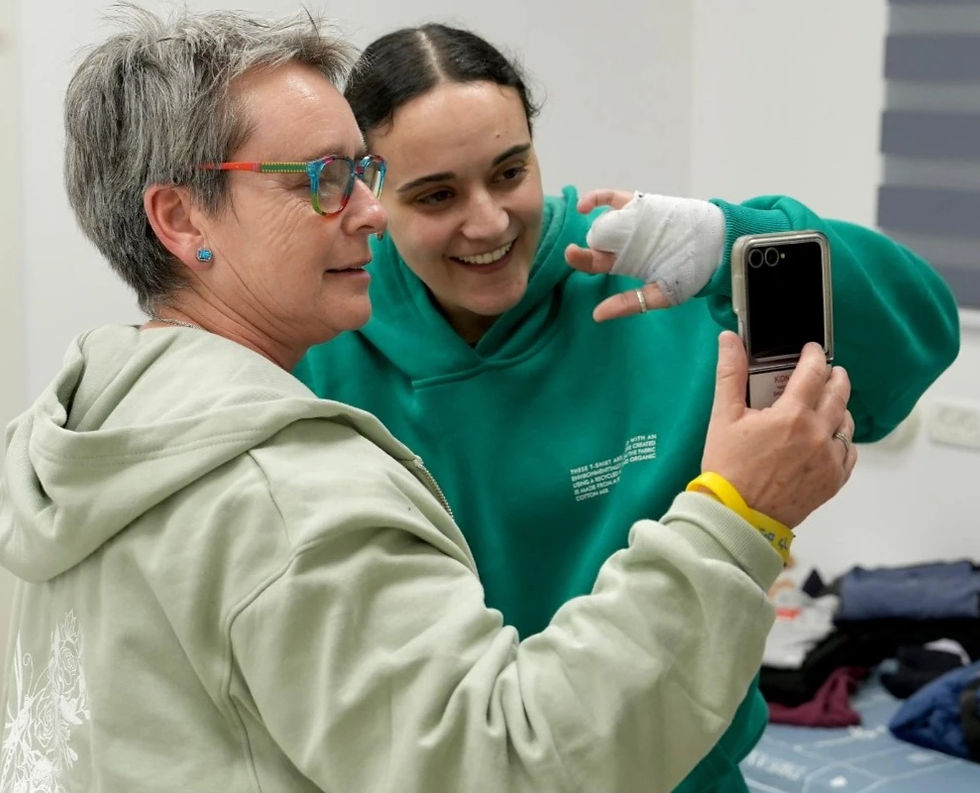
140 terrorists infiltrated the kibbutz.64 residents were murdered. 20 were kidnapped.We spoke of bravery – of those who fought to defend their homes, and of those who returned, including Emily Damari, Doron Steinberger, and Keith Siegel.
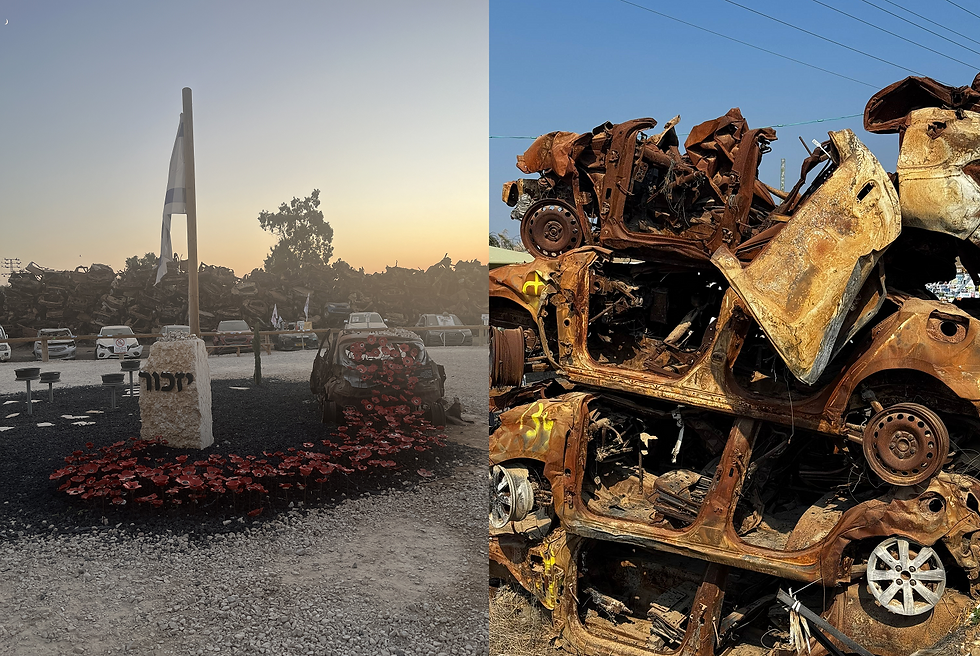
Tekuma – The Burnt Vehicles Site
We stood before the ambulance struck at the Nova festival and heard about Eliakim Libman’s heroism
We learnt about Ben Shimoni, who kept returning to rescue others until he was killed.
Around 1,500 vehicles – some used by terrorists – are displayed here in silent testimony.
Be’eri
101 kibbutz members were murdered – from 10 months to the 88 years old.31 were kidnapped.Eli Sharabi, released after 491 days in captivity, became a beacon of hope for us all.
Team Elchanan (Kalmanzon)
Elchanan, his brother Menahem, and nephew Itiel Zohar arrived independently to help. They saved around 100 people. Elchanan was killed in the process.
Re’im – The Parking Lot Massacre
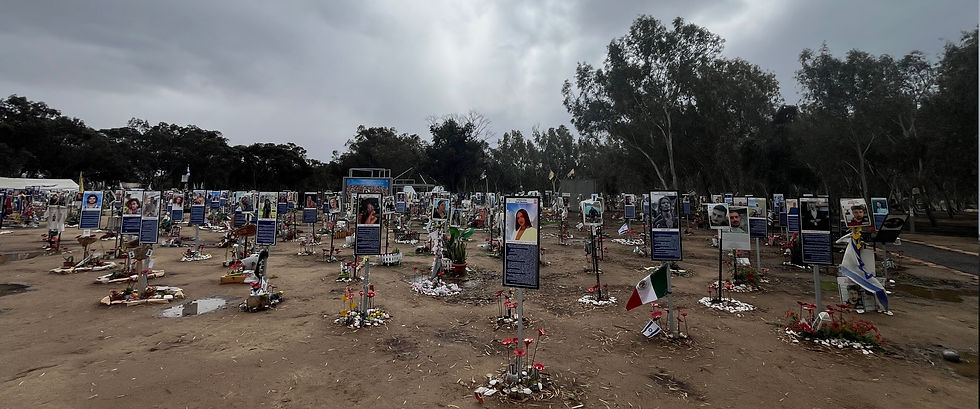
The site of the Nova Festival massacre – 378 murdered, 44 kidnapped.Thousands had come to dance. Many never left.Victims included festivalgoers, security guards, and staff.What began as an informal memorial by loved ones has become a national site of memory.
We remembered Shani Louk, Guy Gilboa Dalal, Alon Ahel, and others – each a universe unto themselves.
Re’im South Shelter – Aner’s Migunit
One of the shelters partygoers fled to during the attack. Many were murdered or kidnapped.We spoke of the bravery of Osama Abu Asa, Aner Shapira, Eitan Hali, and others who shielded others with their own bodies.

The Road Between Pain and Hope
Road 232 is more than a route.It is a path of history, sacrifice, community, and revival.Between Sderot and Nir Oz, between the weight of grief and the courage of rebuilding, lives a community that refuses to surrender.
They choose to plant.To believe.To live.
One initiative we encountered was “Future for the Envelope” – a grassroots movement calling for responsible, locally led rebuilding, under the banner:“No decisions about us – without us!”
We must not forget the price already paid – and we must not rest until the 58 hostages still held by Hamas return home.


Comments